Lowest Common Ancestor of a Binary Search Tree(二叉搜索树的最近公共祖先)
题目 / Problem
中文: 给定一棵二叉搜索树(BST),请找出树中两个指定节点 p 和 q 的最近公共祖先(LCA)。
最近公共祖先是同时拥有 p 和 q 作为后代的最深节点,其中允许一个节点成为它自己的后代。换句话说,如果 p 是 q 的祖先,那么 p 也可以是它们的最近公共祖先。
The lowest common ancestor is the deepest node that has both p and q as descendants, and a node is allowed to be a descendant of itself.
English: Given a binary search tree (BST), find the lowest common ancestor (LCA) node of two given nodes in the BST.
示例 / Examples
以下三个示例使用的二叉搜索树结构:
The following binary search tree is used in the examples:
          6
        /   \
       2     8
      / \   / \
     0   4 7   9
        / \
       3   5
Example 1
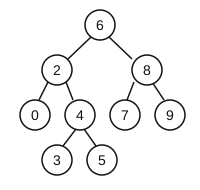
Input:  root = [6,2,8,0,4,7,9,null,null,3,5], p = 2, q = 8
Output: 6

解释 / Explanation:
节点 2 和节点 8 分别位于节点 6 的两侧,因此最近公共祖先是 6。
Nodes 2 and 8 lie on opposite sides of node 6, so their LCA is 6.
Example 2
Input:  root = [6,2,8,0,4,7,9,null,null,3,5], p = 2, q = 4
Output: 2

解释 / Explanation:
节点 2 是节点 4 的祖先。由于节点可以是自己的后代,因此最近公共祖先是 2。
Node 2 is an ancestor of node 4. Because a node can be a descendant of itself, their LCA is 2.
Example 3
Input:  root = [2,1], p = 2, q = 1
Output: 2
约束 / Constraints
- 树中的节点数在
[2, 10⁵]范围内。
The number of nodes in the tree is in the range[2, 10⁵]. -10⁹ <= Node.val <= 10⁹- 所有节点的值互不相同。
AllNode.valvalues are unique. p != qp和q一定存在于这棵二叉搜索树中。
Bothpandqexist in the BST.
解题思路:利用 BST 的有序性质 / Approach: Use the BST Ordering Property
二叉搜索树中的每个节点都满足:
Every node in a binary search tree satisfies:
- 左子树中的所有值都小于当前节点的值。
Every value in the left subtree is smaller than the current node's value. - 右子树中的所有值都大于当前节点的值。
Every value in the right subtree is greater than the current node's value.
从根节点开始,设当前节点为 current:
Starting at the root, let the current node be current:
- 如果
p.val和q.val都小于current.val,说明两个节点都在左子树中,继续向左搜索。
If bothp.valandq.valare smaller thancurrent.val, both nodes are in the left subtree, so continue left. - 如果
p.val和q.val都大于current.val,说明两个节点都在右子树中,继续向右搜索。
If both values are greater thancurrent.val, both nodes are in the right subtree, so continue right. - 否则,两个节点位于当前节点的两侧,或者当前节点就是
p或q。此时current就是最近公共祖先。
Otherwise, the nodes lie on opposite sides, orcurrentis itselfporq. In either case,currentis the LCA.
这个“分叉点”是从根节点向下搜索时遇到的第一个同时覆盖 p 和 q 的节点,因此它就是最深的公共祖先。
This split point is the first node encountered from the root that contains both p and q in its subtree, so it is their lowest common ancestor.
JavaScript 实现 / JavaScript Implementation
/**
 * Definition for a binary tree node.
 * function TreeNode(val) {
 *   this.val = val;
 *   this.left = this.right = null;
 * }
 */

/**
 * @param {TreeNode} root
 * @param {TreeNode} p
 * @param {TreeNode} q
 * @return {TreeNode}
 */
function lowestCommonAncestor(root, p, q) {
  let current = root;

  while (current !== null) {
    if (p.val < current.val && q.val < current.val) {
      current = current.left;
    } else if (p.val > current.val && q.val > current.val) {
      current = current.right;
    } else {
      return current;
    }
  }

  return null;
}
题目保证 p 和 q 都存在于树中,因此按照约束一定会在循环中找到最近公共祖先。末尾的 return null 只是函数的兜底返回值。
The problem guarantees that both nodes exist in the tree, so the LCA will be found inside the loop. The final return null is only a fallback.
执行过程 / Walkthrough
Example 1:p = 2,q = 8
当前节点 / current | 比较 / Comparison | 操作 / Action |
|---|---|---|
6 | 2 < 6 < 8 | 两个节点在两侧,返回 6 / Nodes split; return 6 |
Example 2:p = 2,q = 4
当前节点 / current | 比较 / Comparison | 操作 / Action |
|---|---|---|
6 | 2 < 6 且 4 < 6 | 两者都在左侧,移动到 2 / Both are left; move to 2 |
2 | current === p | 当前节点就是公共祖先,返回 2 / Current node is the LCA; return 2 |
当 current 等于 p 时,两个值不可能同时严格小于或严格大于 current.val,所以会进入 else 并正确返回 p。
When current equals p, both values cannot be strictly smaller or strictly greater than current.val, so execution reaches else and correctly returns p.
复杂度 / Complexity
设二叉搜索树的高度为 h。
Let the height of the binary search tree be h.
- 时间复杂度:
O(h),每次只沿树的一条路径向下移动。
Time:O(h), because the algorithm follows only one path down the tree.- 平衡二叉搜索树中为
O(log n)。
It isO(log n)in a balanced BST. - 树退化为链表时,最坏为
O(n)。
It isO(n)in the worst case when the tree is skewed.
- 平衡二叉搜索树中为
- 空间复杂度:
O(1),迭代解法只使用一个额外指针。
Space:O(1), because the iterative solution uses only one extra pointer.
递归解法 / Recursive Approach
同样的判断逻辑也可以递归实现:
The same decision process can be implemented recursively:
function lowestCommonAncestorRecursive(root, p, q) {
  if (p.val < root.val && q.val < root.val) {
    return lowestCommonAncestorRecursive(root.left, p, q);
  }

  if (p.val > root.val && q.val > root.val) {
    return lowestCommonAncestorRecursive(root.right, p, q);
  }

  return root;
}
- 时间复杂度 / Time:
O(h) - 空间复杂度 / Space:
O(h),递归调用栈的深度取决于树高。
The recursion stack depth depends on the height of the tree.
由于节点数最多达到 10⁵,极度倾斜的树可能使递归调用栈过深,因此迭代解法更加稳妥。
Because the tree may contain up to 10⁵ nodes, a highly skewed tree can make the recursion stack too deep, so the iterative solution is safer.
与普通二叉树解法的区别 / Difference from a General Binary Tree
普通二叉树没有“左小右大”的性质,通常需要分别搜索左右子树,时间复杂度为 O(n)。
A general binary tree lacks the ordered left-smaller/right-greater property, so both subtrees usually need to be searched, resulting in O(n) time.
本题是二叉搜索树,可以根据节点值直接排除一整棵子树,将搜索限制在一条路径上。
Because this problem uses a BST, node values let us eliminate an entire subtree and restrict the search to a single path.
易错点 / Common Pitfalls
- 不要忽略二叉搜索树的有序性质,否则会写成普通二叉树的
O(n)解法。
Use the BST ordering property instead of defaulting to the generalO(n)binary-tree solution. - 最近公共祖先可以是
p或q本身。
The LCA may beporqitself. - 只有当两个节点都严格小于或都严格大于当前节点时,才能继续向同一侧移动。
Move to one side only when both nodes are strictly smaller or both are strictly greater than the current node. - 返回的是节点对象,不是节点的值。
Return the node object, not its value. - 不需要假设
p.val < q.val;当前判断对两种顺序都适用。
Do not assumep.val < q.val; the comparisons work in either order.