Reverse Linked List(反转链表)
题目 / Problem
中文: 给定一个单链表的头节点 head,反转链表并返回反转后的链表。
English: Given the head of a singly linked list, reverse the list and return the reversed list.
示例 / Examples
Example 1
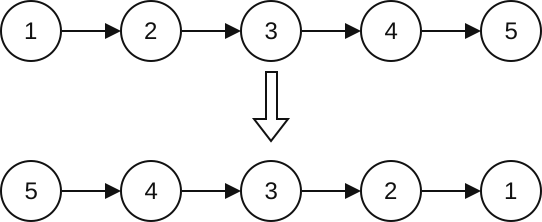
Input:  head = [1,2,3,4,5]
Output: [5,4,3,2,1]
反转前 / Before:
1 → 2 → 3 → 4 → 5 → null

反转后 / After:
null ← 1 ← 2 ← 3 ← 4 ← 5
                         ↑
                       head
Example 2
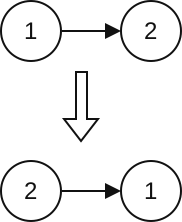
Input:  head = [1,2]
Output: [2,1]
1 → 2 → null

2 → 1 → null
Example 3
Input:  head = []
Output: []
约束 / Constraints
- 链表中的节点数在
[0, 5000]范围内。
The number of nodes in the list is in the range[0, 5000]. -5000 <= Node.val <= 5000
进阶 / Follow-up
链表既可以通过迭代方式反转,也可以通过递归方式反转。请实现这两种方法。
A linked list can be reversed either iteratively or recursively. Implement both approaches.
解题思路一:迭代 / Approach 1: Iteration
遍历链表,并将每个节点的 next 指针改为指向它的前一个节点。需要维护三个指针:
Traverse the list and redirect each node's next pointer to its previous node. Maintain three pointers:
previous:已经反转部分的头节点,也是当前节点反转后应指向的节点。previous: the head of the reversed portion and the node the current node should point to.current:当前正在处理的节点。current: the node currently being processed.next:提前保存的下一个节点,防止修改current.next后丢失未处理部分。next: the next node saved before changingcurrent.next, preventing loss of the unprocessed portion.
每轮执行以下操作:
Perform these steps in every iteration:
1. next = current.next       保存后继节点 / Save the next node
2. current.next = previous  反转当前指针 / Reverse the current pointer
3. previous = current       前移 previous / Advance previous
4. current = next           前移 current / Advance current
当 current 变为 null 时,previous 指向原链表的最后一个节点,也就是反转后链表的新头节点。
When current becomes null, previous points to the original tail, which is the new head of the reversed list.
JavaScript 实现 / JavaScript Implementation
/**
 * Definition for singly-linked list.
 * function ListNode(val, next) {
 *   this.val = val ?? 0;
 *   this.next = next ?? null;
 * }
 */

/**
 * @param {ListNode} head
 * @return {ListNode}
 */
function reverseList(head) {
  let previous = null;
  let current = head;

  while (current !== null) {
    const next = current.next;
    current.next = previous;
    previous = current;
    current = next;
  }

  return previous;
}
执行过程 / Walkthrough
以 head = [1,2,3,4,5] 为例:
For head = [1,2,3,4,5]:
| 轮次 / Round | previous | current | next | 已反转部分 / Reversed Portion |
|---|---|---|---|---|
| 初始 / Start | null | 1 | — | null |
| 1 | 1 | 2 | 2 | 1 → null |
| 2 | 2 | 3 | 3 | 2 → 1 → null |
| 3 | 3 | 4 | 4 | 3 → 2 → 1 → null |
| 4 | 4 | 5 | 5 | 4 → 3 → 2 → 1 → null |
| 5 | 5 | null | null | 5 → 4 → 3 → 2 → 1 → null |
遍历结束后返回 previous,即节点 5。
After traversal, return previous, which points to node 5.
复杂度 / Complexity
设链表中有 n 个节点。
Let the linked list contain n nodes.
- 时间复杂度:
O(n),每个节点只处理一次。
Time:O(n), because every node is processed once. - 空间复杂度:
O(1),只使用常数个额外指针。
Space:O(1), because only a constant number of extra pointers is used.
解题思路二:递归 / Approach 2: Recursion
递归解法先反转从第二个节点开始的子链表,再将当前头节点接到子链表末尾。
The recursive approach first reverses the sublist beginning at the second node, then attaches the current head to the end of that reversed sublist.
对于链表:
For the list:
1 → 2 → 3 → null
递归返回已经反转的子链表:
The recursive call returns the reversed sublist:
1 → 2 ← 3
然后执行:
Then perform:
head.next.next = head;
head.next = null;
得到:
This produces:
3 → 2 → 1 → null
JavaScript 实现 / JavaScript Implementation
/**
 * @param {ListNode} head
 * @return {ListNode}
 */
function reverseListRecursive(head) {
  if (head === null || head.next === null) {
    return head;
  }

  const newHead = reverseListRecursive(head.next);

  head.next.next = head;
  head.next = null;

  return newHead;
}
递归终止条件 / Base Case
head === null:空链表,直接返回null。
An empty list returnsnull.head.next === null:只有一个节点,它已经是反转后链表的头节点。
A single node is already the head of the reversed list.
为什么要设置 head.next = null? / Why Set head.next = null?
执行 head.next.next = head 后,原来的后继节点已经反向指回 head。如果不清空原来的 head.next,两个节点会互相指向并形成环。
After head.next.next = head, the original next node points back to head. Without clearing head.next, the two nodes would point to each other and form a cycle.
递归复杂度 / Recursive Complexity
- 时间复杂度 / Time:
O(n) - 空间复杂度 / Space:
O(n),递归调用栈中最多保存n层。
The recursion stack may contain up tonframes.
由于链表最多包含 5000 个节点,某些 JavaScript 运行环境可能因递归层数过深而发生调用栈溢出,因此迭代解法更加稳妥。
Because the list may contain 5000 nodes, some JavaScript runtimes may overflow the call stack with deep recursion, making the iterative solution safer.
迭代与递归对比 / Iteration vs. Recursion
| 方式 / Approach | 时间 / Time | 额外空间 / Extra Space | 特点 / Notes |
|---|---|---|---|
| 迭代 / Iteration | O(n) | O(1) | 空间更优,不受递归深度限制 / Space-efficient; no recursion-depth limit |
| 递归 / Recursion | O(n) | O(n) | 代码简洁,但使用调用栈 / Concise but uses the call stack |
迭代解法通常是本题更推荐的实现。
The iterative approach is generally preferred for this problem.
易错点 / Common Pitfalls
- 修改
current.next之前必须先保存current.next,否则会丢失剩余链表。
Savecurrent.nextbefore modifying it, or the remainder of the list will be lost. - 迭代结束后应返回
previous,此时current已经是null。
Returnpreviousafter iteration;currentis alreadynull. previous必须初始化为null,这样原头节点才能成为新链表的尾节点。
Initializeprevioustonullso the original head becomes the new tail.- 递归解法中必须执行
head.next = null,否则可能形成环。
In the recursive solution, sethead.next = nullor a cycle may form. - 空链表和单节点链表不需要额外处理,两个实现都应原样返回。
Empty and single-node lists require no reversal and should be returned as-is.