Diameter of Binary Tree(二叉树的直径)
题目 / Problem
中文: 给定一棵二叉树的根节点 root,返回这棵树的直径长度。
二叉树的直径是树中任意两个节点之间最长路径的长度。这条路径可能经过根节点,也可能不经过根节点。
两个节点之间路径的长度使用它们之间的边数表示,而不是节点数。
English: Given the root of a binary tree, return the length of the diameter of the tree.
The diameter of a binary tree is the length of the longest path between any two nodes in the tree. This path may or may not pass through the root.
The length of a path between two nodes is represented by the number of edges between them.
示例 / Examples
Example 1
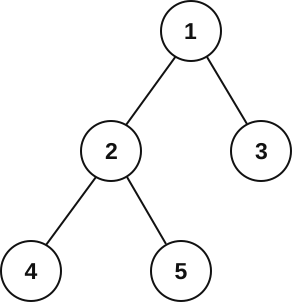
Input:  root = [1,2,3,4,5]
Output: 3
        1
       / \
      2   3
     / \
    4   5
最长路径可以是 [4,2,1,3] 或 [5,2,1,3]。路径包含 4 个节点、3 条边,因此直径为 3。
The longest path can be [4,2,1,3] or [5,2,1,3]. It contains 4 nodes and 3 edges, so the diameter is 3.
Example 2
Input:  root = [1,2]
Output: 1
    1
   /
  2
节点 1 和 2 之间只有一条边,因此直径为 1。
There is one edge between nodes 1 and 2, so the diameter is 1.
约束 / Constraints
- 树中的节点数在
[1, 10⁴]范围内。
The number of nodes in the tree is in the range[1, 10⁴]. -100 <= Node.val <= 100
关键观察 / Key Observation
对于任意节点 node,经过该节点的最长路径由两部分组成:
For any node node, the longest path passing through it consists of two parts:
- 从
node向下延伸到左子树最深节点的路径。
The path fromnodedown to the deepest node in its left subtree. - 从
node向下延伸到右子树最深节点的路径。
The path fromnodedown to the deepest node in its right subtree.
如果左子树深度为 leftDepth,右子树深度为 rightDepth,那么经过当前节点的路径长度为:
If the left and right subtree depths are leftDepth and rightDepth, the path length through the current node is:
leftDepth + rightDepth
整棵树的直径就是所有节点对应路径长度中的最大值。
The tree's diameter is the maximum of this path length over all nodes.
解题思路:后序深度优先搜索 / Approach: Postorder DFS
计算当前节点的深度之前,必须先知道左右子树的深度,因此使用后序遍历:
The depths of both subtrees must be known before calculating the current node's depth, so use postorder traversal:
- 递归计算左子树深度
leftDepth。
Recursively calculateleftDepth. - 递归计算右子树深度
rightDepth。
Recursively calculaterightDepth. - 使用
leftDepth + rightDepth更新全局最大直径。
Update the global maximum diameter withleftDepth + rightDepth. - 向父节点返回当前子树的最大深度:
Math.max(leftDepth, rightDepth) + 1。
Return the current subtree's maximum depth to its parent:Math.max(leftDepth, rightDepth) + 1.
深度函数返回以节点数计算的向下最长路径长度:空节点返回 0,叶子节点返回 1。这样 leftDepth + rightDepth 正好等于经过当前节点的边数。
The depth function measures a downward path in nodes: a null node returns 0, and a leaf returns 1. With this convention, leftDepth + rightDepth equals the number of edges in the path through the current node.
JavaScript 实现 / JavaScript Implementation
/**
 * Definition for a binary tree node.
 * function TreeNode(val, left, right) {
 *   this.val = val ?? 0;
 *   this.left = left ?? null;
 *   this.right = right ?? null;
 * }
 */

/**
 * @param {TreeNode} root
 * @return {number}
 */
function diameterOfBinaryTree(root) {
  let diameter = 0;

  function getDepth(node) {
    if (node === null) {
      return 0;
    }

    const leftDepth = getDepth(node.left);
    const rightDepth = getDepth(node.right);

    diameter = Math.max(diameter, leftDepth + rightDepth);

    return Math.max(leftDepth, rightDepth) + 1;
  }

  getDepth(root);
  return diameter;
}
执行过程 / Walkthrough
以 root = [1,2,3,4,5] 为例,后序遍历从叶子节点开始向上计算:
For root = [1,2,3,4,5], postorder traversal calculates values upward from the leaves:
| 当前节点 / Node | leftDepth | rightDepth | 经过节点的路径 / Path Through Node | 返回深度 / Returned Depth | 当前直径 / Diameter |
|---|---|---|---|---|---|
4 | 0 | 0 | 0 | 1 | 0 |
5 | 0 | 0 | 0 | 1 | 0 |
2 | 1 | 1 | 2 | 2 | 2 |
3 | 0 | 0 | 0 | 1 | 2 |
1 | 2 | 1 | 3 | 3 | 3 |
在根节点 1 处,左子树深度为 2,右子树深度为 1,所以经过根节点的路径有 2 + 1 = 3 条边,最终返回 3。
At root node 1, the left subtree depth is 2 and the right subtree depth is 1, so the path through the root contains 2 + 1 = 3 edges. The final answer is 3.
为什么最长路径不一定经过根节点? / Why Might the Diameter Skip the Root?
某棵子树内部可能包含比任何经过整棵树根节点的路径更长的路径。例如:
A subtree may contain a path longer than every path passing through the tree's root. For example:
          1
         /
        2
       / \
      3   4
     /     \
    5       6
最长路径 5 → 3 → 2 → 4 → 6 不经过根节点 1。
The longest path 5 → 3 → 2 → 4 → 6 does not pass through root node 1.
因此不能只计算根节点的 leftDepth + rightDepth。必须在访问每个节点时都更新最大直径。
Therefore, calculating leftDepth + rightDepth only at the root is insufficient. Update the maximum diameter at every node.
复杂度 / Complexity
设树中有 n 个节点,树高为 h。
Let the tree contain n nodes and have height h.
- 时间复杂度:
O(n),每个节点只访问一次。
Time:O(n), because every node is visited once. - 空间复杂度:
O(h),空间由递归调用栈占用。
Space:O(h), for the recursion stack.- 平衡二叉树中为
O(log n)。
It isO(log n)for a balanced tree. - 树退化为链表时,最坏为
O(n)。
It isO(n)in the worst case for a skewed tree.
- 平衡二叉树中为
低效解法对比 / Inefficient Approach
一种直观做法是对每个节点分别调用高度函数,再计算 leftDepth + rightDepth。这种方法会重复遍历相同子树。
A straightforward solution calls a separate height function at every node and calculates leftDepth + rightDepth. This repeatedly traverses the same subtrees.
在退化二叉树中,它的时间复杂度可能达到 O(n²)。后序遍历在一次 DFS 中同时计算深度和直径,将时间复杂度优化为 O(n)。
For a skewed tree, that approach can take O(n²) time. Postorder traversal computes both depth and diameter during one DFS, reducing the time complexity to O(n).
易错点 / Common Pitfalls
- 直径使用边数表示,不是路径中的节点数。
The diameter is measured in edges, not nodes. - 最长路径不一定经过根节点,必须在每个节点处更新答案。
The longest path may not pass through the root, so update the answer at every node. - 深度函数应向父节点返回单边最大深度,不能返回
leftDepth + rightDepth。
The depth function must return the maximum one-sided depth to its parent, notleftDepth + rightDepth. leftDepth + rightDepth只用于更新经过当前节点的直径候选值。
UseleftDepth + rightDepthonly to update the diameter candidate through the current node.- 单节点树的直径为
0,因为其中没有边。
A single-node tree has diameter0because it contains no edges. - 节点数量最多为
10⁴,极度倾斜的树可能使部分 JavaScript 环境的递归调用栈过深。
With up to10⁴nodes, a highly skewed tree may exceed the recursion limit in some JavaScript environments.