Binary Tree Level Order Traversal(二叉树的层序遍历)
题目 / Problem
中文: 给定一棵二叉树的根节点 root,返回其节点值的层序遍历结果,即从上到下逐层访问,每层从左到右排列。
English: Given the root of a binary tree, return the level-order traversal of its nodes' values—that is, from left to right, level by level.
示例 / Examples
Example 1
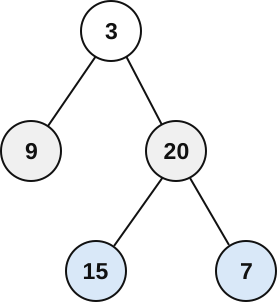
Input:  root = [3,9,20,null,null,15,7]
Output: [[3],[9,20],[15,7]]
        3          → [3]
       / \
      9  20        → [9, 20]
         / \
        15  7      → [15, 7]
按照从上到下、每层从左到右的顺序,结果为 [[3],[9,20],[15,7]]。
Reading from top to bottom and left to right within each level produces [[3],[9,20],[15,7]].
Example 2
Input:  root = [1]
Output: [[1]]
单节点树只有一层。
A single-node tree has only one level.
Example 3
Input:  root = []
Output: []
空树不包含任何层,因此返回空数组。
An empty tree contains no levels, so return an empty array.
约束 / Constraints
- 树中的节点数在
[0, 2000]范围内。
The number of nodes in the tree is in the range[0, 2000]. -1000 <= Node.val <= 1000
解题思路:广度优先搜索 / Approach: Breadth-First Search
层序遍历天然适合使用队列。队列先进先出的特性可以保证:
Level-order traversal naturally uses a queue. Its first-in, first-out behavior guarantees that:
- 上一层节点先于下一层节点被处理。
Nodes in an earlier level are processed before nodes in a later level. - 同一层中,左侧节点先于右侧节点被处理。
Within a level, left-side nodes are processed before right-side nodes.
处理步骤:
Processing steps:
- 如果
root === null,直接返回[]。
Ifroot === null, return[]immediately. - 将根节点加入队列。
Enqueue the root node. - 每轮开始时记录当前队列中的本层节点数
levelSize。
At the start of each round, record the number of current-level nodes aslevelSize. - 连续取出
levelSize个节点,将它们的值保存到当前层数组。
Dequeue exactlylevelSizenodes and store their values in the current-level array. - 按先左后右的顺序,将非空子节点加入队列。
Enqueue non-null children in left-to-right order. - 当前层处理完后,将它加入最终结果。
Append the completed level to the final result.
JavaScript 实现 / JavaScript Implementation
/**
 * Definition for a binary tree node.
 * function TreeNode(val, left, right) {
 *   this.val = val ?? 0;
 *   this.left = left ?? null;
 *   this.right = right ?? null;
 * }
 */

/**
 * @param {TreeNode} root
 * @return {number[][]}
 */
function levelOrder(root) {
  if (root === null) {
    return [];
  }

  const result = [];
  const queue = [root];
  let front = 0;

  while (front < queue.length) {
    const levelSize = queue.length - front;
    const level = [];

    for (let i = 0; i < levelSize; i++) {
      const node = queue[front++];
      level.push(node.val);

      if (node.left !== null) {
        queue.push(node.left);
      }

      if (node.right !== null) {
        queue.push(node.right);
      }
    }

    result.push(level);
  }

  return result;
}
这里使用索引 front 读取队列,而没有使用 JavaScript 数组的 shift()。shift() 可能在每次调用时移动剩余元素,带来额外开销。
An index named front reads from the queue instead of using JavaScript's shift(), which may move all remaining elements on every call.
执行过程 / Walkthrough
以 Example 1 为例:
For Example 1:
第 1 层 / Level 1
处理前队列 / Queue before: [3]
本层节点数 / levelSize: 1
本层结果 / level: [3]
加入子节点 / Enqueue: 9, 20
处理后队列 / Remaining queue: [9, 20]
第 2 层 / Level 2
处理前队列 / Queue before: [9, 20]
本层节点数 / levelSize: 2
本层结果 / level: [9, 20]
加入子节点 / Enqueue: 15, 7
处理后队列 / Remaining queue: [15, 7]
第 3 层 / Level 3
处理前队列 / Queue before: [15, 7]
本层节点数 / levelSize: 2
本层结果 / level: [15, 7]
加入子节点 / Enqueue: none
处理后队列 / Remaining queue: []
最终结果:
Final result:
[[3],[9,20],[15,7]]
为什么要提前保存 levelSize? / Why Capture levelSize First?
处理当前层节点时,它们的子节点会不断加入队列。如果循环直接使用持续变化的 queue.length,下一层节点可能会被错误地放入当前层。
While current-level nodes are processed, their children are continually added to the queue. If the loop uses the changing queue.length directly, next-level nodes may be incorrectly included in the current level.
在每轮开始时固定:
At the start of each round, fix:
const levelSize = queue.length - front;
然后只处理这 levelSize 个节点,就能准确划分层级。
Processing exactly these levelSize nodes keeps level boundaries correct.
复杂度 / Complexity
设树中有 n 个节点,最大宽度为 w。
Let the tree contain n nodes and have maximum width w.
- 时间复杂度:
O(n),每个节点入队和读取各一次。
Time:O(n), because every node is enqueued and read once. - 空间复杂度:
O(n),队列数组在整个过程中保存所有节点引用;若使用可回收已出队空间的标准队列,活动队列最多为O(w)。
Space:O(n)for this array-backed queue, which retains all node references. With a standard queue that reclaims dequeued storage, the active queue is at mostO(w). - 返回结果本身需要
O(n)空间。
The returned result itself requiresO(n)space.
DFS 解法:按深度分组 / DFS Approach: Group by Depth
也可以使用深度优先搜索,并将节点值放入与其深度对应的数组:
Depth-first search can also place each node value into the array corresponding to its depth:
function levelOrderDFS(root) {
  const result = [];

  function traverse(node, depth) {
    if (node === null) {
      return;
    }

    if (result.length === depth) {
      result.push([]);
    }

    result[depth].push(node.val);
    traverse(node.left, depth + 1);
    traverse(node.right, depth + 1);
  }

  traverse(root, 0);
  return result;
}
先递归左子树再递归右子树,可以保证每一层内部仍按从左到右的顺序加入。
Recursing into the left subtree before the right preserves left-to-right order within each level.
- 时间复杂度 / Time:
O(n) - 空间复杂度 / Space:
O(h)递归调用栈,加上O(n)返回结果;h是树高。
The recursion stack usesO(h)space, in addition to theO(n)result;his the tree height.
BFS 与 DFS 对比 / BFS vs. DFS
| 方法 / Method | 时间 / Time | 辅助空间 / Auxiliary Space | 特点 / Notes |
|---|---|---|---|
| BFS | O(n) | 活动队列通常记为 O(w) | 与层序遍历定义直接对应 / Directly matches level order |
| DFS | O(n) | O(h) | 使用深度作为结果下标 / Uses depth as the result index |
BFS 更直观地体现“逐层处理”,通常是本题的首选解法。
BFS directly models level-by-level processing and is generally the preferred solution.
易错点 / Common Pitfalls
- 空树应返回
[],不能返回[[]]。
Return[]for an empty tree, not[[]]. - 每轮必须先固定
levelSize,再处理当前层。
CapturelevelSizebefore processing each level. - 子节点应按先左后右的顺序加入队列。
Enqueue the left child before the right child. - 返回结果是二维数组,每一层对应一个独立数组。
The result is a two-dimensional array with one separate array per level. - 不要把所有节点值放入同一个一维数组。
Do not place every node value into a single flat array. - DFS 写法需要以深度作为结果数组的下标,并先创建不存在的层。
In the DFS version, use depth as the result index and create each level before adding values.