Minimum Height Trees(最小高度树)
题目 / Problem
中文: 树是一种无向图,其中任意两个顶点之间恰好存在一条路径。换句话说,树是一个连通且没有简单环的图。
给定一棵包含 n 个节点的树,节点编号为 0 到 n - 1。edges 包含 n - 1 条无向边,其中 edges[i] = [ai, bi] 表示节点 ai 和 bi 之间存在一条边。
可以选择任意节点作为根。以某个节点为根时,树的高度是从根到最远叶子节点的路径边数。返回所有能够使树高最小的根节点编号,答案顺序不限。
English: A tree is an undirected graph in which any two vertices are connected by exactly one path—a connected graph without simple cycles.
Given a tree with n nodes labeled from 0 to n - 1 and n - 1 undirected edges, any node may be selected as the root. The tree's height is the number of edges on the longest downward path from the root to a leaf.
Return all root labels that produce the minimum possible height. The answer may be returned in any order.
示例 / Examples
Example 1
Input:  n = 4, edges = [[1,0],[1,2],[1,3]]
Output: [1]
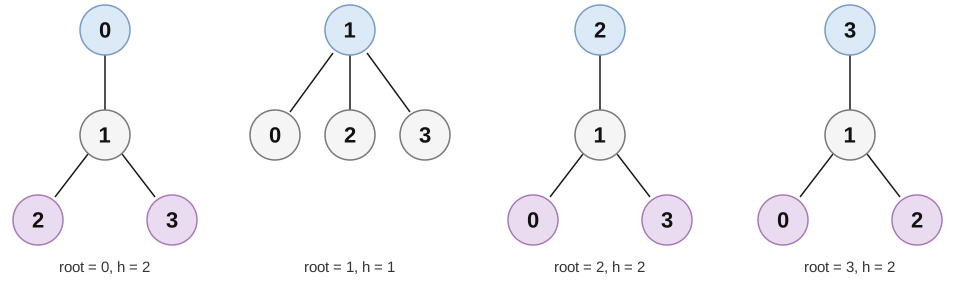
只有以节点 1 为根时树高为 1,其他根节点都会产生高度为 2 的树。
Only node 1 produces a tree of height 1; every other root produces height 2.
Example 2
Input:  n = 6, edges = [[3,0],[3,1],[3,2],[3,4],[5,4]]
Output: [3,4]
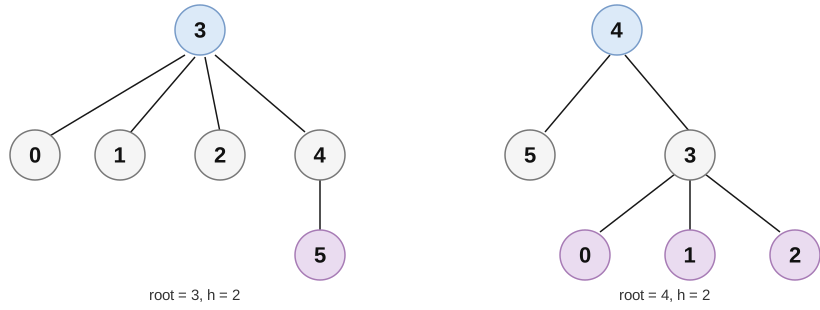
以节点 3 或 4 为根时,树的高度都为 2。
Rooting the tree at either node 3 or node 4 gives height 2.
约束 / Constraints
1 <= n <= 2 × 10^4edges.length === n - 10 <= ai, bi < nai !== bi- 所有边互不相同。
All edge pairs are distinct. - 输入保证是一棵树,不存在重复边。
The input is guaranteed to be a tree with no repeated edges.
核心观察:答案是树的中心 / Key Observation: Tree Centers
如果选择靠近树边缘的节点作为根,到另一侧最远叶子的距离通常很长。为了最小化最大距离,根节点应该位于树的中心。
Choosing a root near the edge of a tree usually creates a long path to a leaf on the opposite side. To minimize the maximum distance, the root must lie at the center of the tree.
一棵树的中心最多只有两个:
A tree has at most two centers:
- 最长路径包含偶数条边时,只有一个中心节点。
If the longest path has an even number of edges, there is one center. - 最长路径包含奇数条边时,有两个相邻的中心节点。
If the longest path has an odd number of edges, there are two adjacent centers.
因此最终答案只可能包含一个或两个节点。
Therefore, the answer contains only one or two nodes.
解题思路:逐层删除叶子 / Approach: Trim Leaves Layer by Layer
度数为 1 的节点是叶子节点。可以像剥洋葱一样,同时删除树最外层的所有叶子:
Nodes with degree 1 are leaves. Remove all outermost leaves simultaneously, like peeling layers from an onion:
外层叶子 / Outer leaves
        ↓ 删除 / remove
新的外层叶子 / New leaves
        ↓ 删除 / remove
树的中心 / Tree center(s)
每删除一层,所有剩余节点到原始边缘的距离都增加一层。最后剩下的一个或两个节点就是树的中心,也就是所有最小高度树的根。
Each removed layer moves one step inward from the original boundary. The final one or two remaining nodes are the tree centers and therefore all minimum-height roots.
这种过程类似无向图上的拓扑排序:
This process resembles topological sorting on an undirected graph:
- 建立邻接表和每个节点的度数。
Build an adjacency list and the degree of every node. - 将所有度数为
1的节点作为第一层叶子。
Collect all degree-1nodes as the first leaf layer. - 当剩余节点数大于
2时,删除当前整层叶子。
While more than two nodes remain, remove the entire current leaf layer. - 对每个被删除叶子的邻居执行
degree[neighbor]--。
Decrement the degree of every removed leaf's neighbor. - 当邻居度数变为
1时,它成为下一层叶子。
When a neighbor's degree becomes1, it becomes a leaf in the next layer.
为什么必须同时删除一层? / Why Remove a Whole Layer Together?
同一层叶子与树中心的距离相同。如果删除一个叶子后立即继续深入,而没有先处理其他叶子,就会破坏按距离分层的过程。
Leaves in the same layer have equal distance from the tree center. Removing one leaf and immediately going deeper before processing the others would break the distance-layer ordering.
因此每一轮要先固定当前 leaves,处理完全部叶子后再切换到 nextLeaves。
Each round must process the entire current leaves array before switching to nextLeaves.
JavaScript 实现 / JavaScript Implementation
/**
 * @param {number} n
 * @param {number[][]} edges
 * @return {number[]}
 */
function findMinHeightTrees(n, edges) {
  if (n === 1) {
    return [0];
  }

  const graph = Array.from({ length: n }, () => []);
  const degree = new Array(n).fill(0);

  for (const [first, second] of edges) {
    graph[first].push(second);
    graph[second].push(first);
    degree[first]++;
    degree[second]++;
  }

  let leaves = [];

  for (let node = 0; node < n; node++) {
    if (degree[node] === 1) {
      leaves.push(node);
    }
  }

  let remainingNodes = n;

  while (remainingNodes > 2) {
    remainingNodes -= leaves.length;
    const nextLeaves = [];

    for (const leaf of leaves) {
      for (const neighbor of graph[leaf]) {
        degree[neighbor]--;

        if (degree[neighbor] === 1) {
          nextLeaves.push(neighbor);
        }
      }
    }

    leaves = nextLeaves;
  }

  return leaves;
}
执行过程 / Walkthrough
使用 Example 2:
Using Example 2:
edges = [[3,0],[3,1],[3,2],[3,4],[5,4]]
初始度数:
Initial degrees:
| 节点 / Node | 0 | 1 | 2 | 3 | 4 | 5 |
|---|---|---|---|---|---|---|
| 度数 / Degree | 1 | 1 | 1 | 4 | 2 | 1 |
第一层叶子为:
The first leaf layer is:
[0,1,2,5]
删除它们后:
After removing them:
- 节点
3的度数从4变为1。
Node3decreases from degree4to1. - 节点
4的度数从2变为1。
Node4decreases from degree2to1.
只剩两个节点:
Only two nodes remain:
[3,4]
因此它们都是最小高度树的根。
Therefore, both are minimum-height tree roots.
为什么不是对每个根计算高度? / Why Not Compute Height for Every Root?
可以对每个节点分别执行一次 BFS 或 DFS 计算树高,但每次搜索需要 O(n),对 n 个根总共需要 O(n²)。
Running BFS or DFS from every possible root would take O(n) per root and O(n²) overall.
当 n 最大为 2 × 10^4 时,平方级方法无法接受。逐层删除叶子只处理每个节点和每条边常数次。
With n up to 2 × 10^4, a quadratic solution is too slow. Leaf trimming processes every node and edge only a constant number of times.
与树的直径的关系 / Relationship to the Tree Diameter
树的直径是任意两个节点之间的最长路径。最小高度树的根正是直径路径中间的一个或两个节点。
The tree diameter is the longest path between any two nodes. Minimum-height roots are precisely the one or two middle nodes of a diameter path.
也可以通过两次 BFS/DFS 找到直径,再取直径中点。本题的叶子删除法不需要显式恢复直径路径,过程更直接。
Another solution finds the diameter with two BFS/DFS passes and selects its midpoint. Leaf trimming is more direct because it does not need to reconstruct the diameter path.
复杂度 / Complexity
树有 n 个节点和 n - 1 条边。
A tree contains n nodes and n - 1 edges.
- 时间复杂度 / Time:
O(n),每个节点成为叶子至多一次,每条边只被处理常数次。
Every node becomes a leaf at most once, and every edge is processed only a constant number of times. - 空间复杂度 / Space:
O(n),用于邻接表、度数数组和叶子数组。O(n)for the adjacency list, degree array, and leaf arrays.
易错点 / Common Pitfalls
n === 1时没有边,唯一答案是[0],必须单独处理。
Whenn === 1, there are no edges and the only answer is[0]; handle it separately.- 这是无向图,建立邻接表时必须同时添加两个方向。
The graph is undirected, so add both directions to the adjacency list. - 初始叶子是度数为
1的节点,不是度数为0的节点。
Initial leaves have degree1, not degree0. - 每轮必须同时删除当前所有叶子,再处理下一层。
Remove every leaf in the current layer before processing the next layer. - 循环条件应为
remainingNodes > 2,因为树的中心可能有两个。
UseremainingNodes > 2because a tree may have two centers. - 最终答案最多包含两个节点,不需要对结果进行额外排序。
The final answer contains at most two nodes and does not require sorting.