Kth Smallest Element in a BST(二叉搜索树中第 K 小的元素)
题目 / Problem
中文: 给定一棵二叉搜索树的根节点 root 和一个整数 k,返回树中所有节点值的第 k 小元素。k 从 1 开始计数。
English: Given the root of a binary search tree and an integer k, return the kth smallest value among all node values. k is 1-indexed.
示例 / Examples
Example 1
Input:  root = [3,1,4,null,2], k = 1
Output: 1
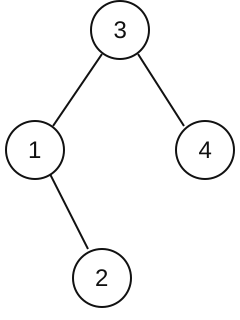
中序遍历结果为 [1,2,3,4],第 1 个元素是 1。
The inorder traversal is [1,2,3,4], whose first element is 1.
Example 2
Input:  root = [5,3,6,2,4,null,null,1], k = 3
Output: 3
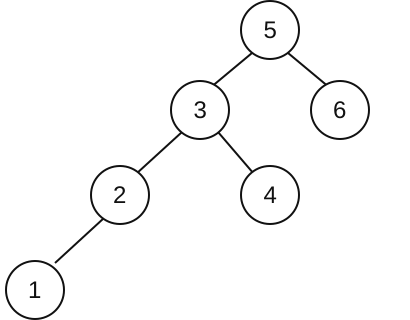
中序遍历结果为 [1,2,3,4,5,6],第 3 个元素是 3。
The inorder traversal is [1,2,3,4,5,6], whose third element is 3.
约束 / Constraints
- 树中节点数量为
n。
The tree containsnnodes. 1 <= k <= n <= 10^40 <= Node.val <= 10^4
核心性质:BST 的中序遍历有序 / Key Property: BST Inorder Is Sorted
二叉搜索树满足:
A binary search tree satisfies:
左子树节点值 < 根节点值 < 右子树节点值
left-subtree values < root value < right-subtree values
中序遍历的访问顺序是:
Inorder traversal visits nodes in this order:
左子树 → 根节点 → 右子树
Left subtree → Root → Right subtree
因此,对 BST 进行中序遍历会按从小到大的顺序访问节点。第 k 个访问到的节点就是第 k 小元素。
Therefore, inorder traversal of a BST visits values from smallest to largest. The kth visited node is the kth smallest value.
解题思路:迭代中序遍历 / Approach: Iterative Inorder Traversal
使用栈模拟递归中序遍历:
Use a stack to simulate recursive inorder traversal:
- 从当前节点不断向左移动,并将沿途节点压入栈。
Move left repeatedly, pushing every visited node onto the stack. - 无法继续向左时,弹出栈顶节点。
When no further left move is possible, pop the top node. - 该节点是当前尚未访问节点中的最小值,计数加一。
This node is the smallest unvisited value, so increment the visit count. - 如果计数等于
k,直接返回该节点值。
If the count equalsk, return the node's value immediately. - 否则转向该节点的右子树,重复以上过程。
Otherwise, move to its right subtree and repeat.
算法不需要生成完整的有序数组,找到第 k 个节点后即可提前停止。
There is no need to construct the complete sorted array; stop as soon as the kth node is reached.
栈的作用 / Role of the Stack
栈保存“已经到达但还不能访问”的祖先节点:
The stack stores ancestors that have been reached but cannot yet be visited:
        5
       /
      3
     /
    2
   /
  1

向左下降后的栈 / Stack after descending left:
[5, 3, 2, 1]
弹出顺序从最左节点开始,因此符合中序遍历的升序要求。
Popping begins with the leftmost node, preserving the ascending inorder order.
JavaScript 实现 / JavaScript Implementation
/**
 * Definition for a binary tree node.
 * function TreeNode(val, left, right) {
 *   this.val = val ?? 0;
 *   this.left = left ?? null;
 *   this.right = right ?? null;
 * }
 */

/**
 * @param {TreeNode} root
 * @param {number} k
 * @return {number}
 */
function kthSmallest(root, k) {
  const stack = [];
  let current = root;
  let visited = 0;

  while (current !== null || stack.length > 0) {
    while (current !== null) {
      stack.push(current);
      current = current.left;
    }

    current = stack.pop();
    visited++;

    if (visited === k) {
      return current.val;
    }

    current = current.right;
  }

  // 题目保证 1 <= k <= 节点数量,因此不会执行到这里。
  // Constraints guarantee a valid k, so this line is unreachable.
  return -1;
}
执行过程 / Walkthrough
使用 Example 2:
Using Example 2:
        5
       / \
      3   6
     / \
    2   4
   /
  1
中序访问过程:
Inorder visits:
| 访问次序 / Visit | 节点值 / Value | 是否达到 k = 3 / Reached k? |
|---|---|---|
| 1 | 1 | 否 / No |
| 2 | 2 | 否 / No |
| 3 | 3 | 是 / Yes,返回 3 / return 3 |
节点 4、5 和 6 不需要继续访问。
Nodes 4, 5, and 6 do not need to be visited.
递归写法 / Recursive Version
也可以使用递归中序遍历,并在找到答案后停止继续搜索:
A recursive inorder traversal can also stop after finding the answer:
function kthSmallest(root, k) {
  let remaining = k;
  let answer = -1;

  function inorder(node) {
    if (node === null || remaining === 0) {
      return;
    }

    inorder(node.left);

    if (remaining === 0) {
      return;
    }

    remaining--;

    if (remaining === 0) {
      answer = node.val;
      return;
    }

    inorder(node.right);
  }

  inorder(root);
  return answer;
}
迭代版本不会受到 JavaScript 递归调用栈深度的限制,更适合可能严重偏斜的树。
The iterative version avoids JavaScript recursion-depth limits and is safer for highly skewed trees.
进阶:频繁修改和查询 / Follow-up: Frequent Updates and Queries
如果 BST 经常进行插入、删除,并且频繁查询第 k 小元素,可以为每个节点维护:
If the BST is frequently updated and queried, augment every node with:
subtreeSize = 以当前节点为根的子树节点数量
              number of nodes in the current node's subtree
查询时,设左子树大小为 leftSize:
During a query, let leftSize be the size of the left subtree:
- 如果
k === leftSize + 1,当前节点就是答案。
Ifk === leftSize + 1, the current node is the answer. - 如果
k <= leftSize,答案位于左子树。
Ifk <= leftSize, search the left subtree. - 如果
k > leftSize + 1,答案位于右子树,并令k -= leftSize + 1。
Ifk > leftSize + 1, search the right subtree withk -= leftSize + 1.
function kthSmallestWithSize(root, k) {
  let current = root;

  while (current !== null) {
    const leftSize = current.left?.subtreeSize ?? 0;

    if (k === leftSize + 1) {
      return current.val;
    }

    if (k <= leftSize) {
      current = current.left;
    } else {
      k -= leftSize + 1;
      current = current.right;
    }
  }

  return -1;
}
插入或删除节点时,需要沿搜索路径更新所有祖先节点的 subtreeSize。
When inserting or deleting a node, update subtreeSize for every ancestor along the search path.
如果使用 AVL 树、红黑树等平衡 BST,并维护子树大小:
With a balanced BST such as an AVL or red-black tree augmented with subtree sizes:
- 插入 / Insert:
O(log n) - 删除 / Delete:
O(log n) - 查询第
k小 / Kth-smallest query:O(log n)
这种结构也称为顺序统计树(Order Statistic Tree)。
This augmented structure is also called an Order Statistic Tree.
复杂度 / Complexity
设树高为 h。
Let h be the tree height.
- 时间复杂度 / Time:
O(h + k),遍历到第k个节点后停止;最坏为O(n)。O(h + k)before stopping at thekth node;O(n)in the worst case. - 空间复杂度 / Space:
O(h),用于显式栈。O(h)for the explicit stack.
平衡树中 h = O(log n),完全偏斜的树中 h = O(n)。
For a balanced tree, h = O(log n); for a completely skewed tree, h = O(n).
易错点 / Common Pitfalls
k从1开始计数,不是从0开始。kis 1-indexed, not 0-indexed.- 必须使用中序遍历“左 → 根 → 右”,不能使用前序或后序遍历。
Use inorder traversal left-root-right, not preorder or postorder. - 找到第
k个节点后可以立即返回,不需要遍历完整棵树。
Return immediately after reaching thekth node; do not traverse the whole tree unnecessarily. - 迭代写法的外层条件是
current !== null || stack.length > 0。
The iterative outer condition iscurrent !== null || stack.length > 0. - 从栈中弹出节点并访问后,应转向它的右子树。
After popping and visiting a node, move to its right subtree. - 进阶方案中,插入、删除和树旋转后都必须正确维护
subtreeSize。
In the augmented solution, maintainsubtreeSizeafter insertions, deletions, and tree rotations.